















Patient-safety legislation moves quietly. Epieme catches every bill as it moves.
Epieme scores 556 bills across 40 states and DC for patient-safety relevance, then links every field back to the source record on LegiScan.


Every bill arrives with its whole paper trail.
Scored for relevance, linked to the source, refreshed every week.
Three things a bill briefing should be.
Every bill in Epieme is all three.


This is everything one bill arrives with.
Every field below belongs to a single record — Alaska HB144, exactly as it stands today.
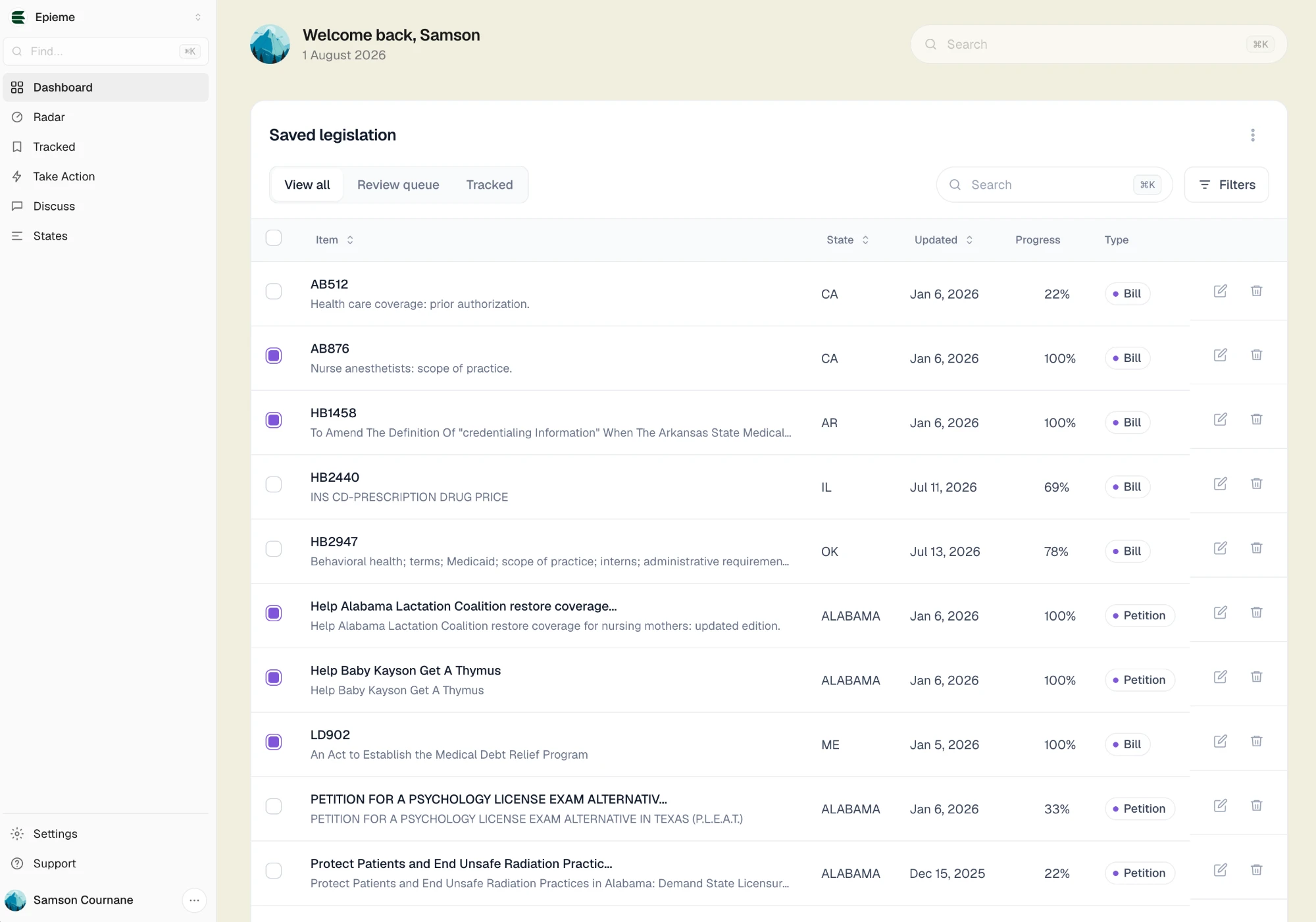
Everything the record says, in one view.
Score, stage, committee, sponsors, sources, and the next step — assembled from the LegiScan record and refreshed weekly.

Scored feed

Every bill is scored for patient-safety relevance before it reaches you. Ranked, not just chronological.

Stage timeline

Introduced, committee, floor, passed — four stages, dated from the source record, so you can see how fast something is moving.

Committee & sponsors

Who holds the bill, who signed on, and how to reach them. 66 committees represented.

Weekly alerts

A weekly digest of what changed in the states you follow.

Suggested actions

Each bill arrives with a next step — email the committee, or attend a hearing when one is scheduled.

Source links

Every field traces back
to the LegiScan record.

Share & brief

Export a bill as a link, or as a short brief a coalition can read.
Take the record with you.
A weekly email digest, an RSS feed, a CSV, a shareable link, hearing dates for your calendar, a brief you can print — every export keeps its LegiScan citations. An API is planned, not available yet.
A public record that nobody reads in time isn’t really public — so we read all 556 bills every week and link every line back to its source.
The alternative to tracking this by hand.
One place for every relevant bill, instead of forty open tabs.
Watching 40 legislature sites
Reading bill text to judge relevance
Rebuilding the action history by hand
Finding the committee and its contact
Tracking what changed this week
Writing the brief for your coalition
All 40 states and DC in one feed
Relevance scored, not keyword-matched
Full action history, already built
Committee and contact on every bill
Weekly digest of what changed
Briefs your coalition can act on
Pricing announced before launch
Built for everyone who has to watch this legislation
— from one family to a national coalition
Advocates & families
Follow the bills that touch your own experience, in your own state. When a hearing is scheduled you hear about it before it happens, not after.

Nonprofits & coalitions
One shared view of every relevant bill across the states you work in, with briefs your members can act on.

Clinicians
See the policy that will change how you practise while it is still in committee, with the source text there to read yourself.

Journalists & researchers
A scored, source-linked corpus of patient-safety legislation, with the full action history behind every bill.

Quick answers to common questions
LegiScan is the source of record. Bill text, action history, committee assignment, and sponsors all come from it, and every field on a bill links back to the entry it came from.
That means you can check the page against the record. Open AK HB144 here, click through to LegiScan, and you should find the same stage, the same committee, and the same last action. Where the two ever disagree, the source wins.
556 bills, across 40 states and the District of Columbia. Behind them sit 66 committees and 5,778 logged legislative actions.
Those numbers are a count, not a target, and they move with every scrape. What the page shows is the total from the most recent run.
Weekly. Each run picks up newly filed bills and every action recorded since the last one. The most recent completed on 2026-07-20.
Weekly is honest about what it is. A bill that moved yesterday shows up in next week's run rather than this afternoon, so the record is complete rather than live. Every action carries the date it was taken, so you can always see how fresh a bill is.
Every bill is scored for patient-safety relevance. Nothing is on the radar because it matched a keyword.
The score. Each bill is scored, and 0.4 is the threshold to appear at all. Below it a bill is not shown; above it the score travels with the bill, so you can see how strong the call was rather than taking it on trust.
The stage. The score is read alongside where the bill actually is — introduced, in committee, on the floor, or passed — because a strong bill sitting in committee asks something different of you than one that has already passed.
The source. Scoring never stands in for the text. The bill's own language and its full action history are on the page, so a judgement you disagree with is one you can check line by line.
What scoring does not do is decide whether a bill is good or bad. It decides whether it is worth your attention. The reading stays yours.
Yes. State legislation only, today.
What is covered. Bills filed in 40 state legislatures and the District of Columbia, followed from introduction through committee, the floor, and passage.
What is not. Congress. Federal bills and federal rulemaking sit outside the corpus, and nothing on these pages is drawn from them.
Why the states. Much of the law that decides how care is actually delivered is written there, in committees most people never hear of — which is also where one email still reaches the person holding the bill.
An alert is deliberately short. It exists so you can tell in a few seconds whether this week asks anything of you.
Three parts.
What changed. The action that triggered it, as the legislature recorded it — a referral, a vote, a hearing set, a new cosponsor.
Why it matters. A line or two on what that action does to the bill's progress, and what the stage it has reached means in practice.
The source link. Straight through to the bill on LegiScan, so the first thing you can do with an alert is verify it.
Yes. Filter to your state and follow only the bills you choose. Nothing is followed on your behalf.
Following works bill by bill, so a list can be as narrow as the two bills you actually care about or as wide as everything filed in your state this session. Alerts cover what you follow and nothing else.
One limit worth knowing: coverage is 40 states plus the District of Columbia. If your legislature is not in that set yet, you can still read everything that is.
The concrete next step for a bill at the stage it is actually at, rather than a general invitation to get involved.
For most bills that step is emailing the committee holding it, and the committee and its contact are already on the bill, so there is nothing to look up. A hearing on the calendar is the rarer case — only 3 bills have one at the moment — so attending is the exception, not the routine.
The suggestion is a starting point, not a script. Rewrite it, or set it aside and work from the bill text on its own. You can go through them in the action center.
No. Epieme does not lobby, does not endorse, and does not take a position on any bill.
What it does is surface the record — the text, the action history, the committee, the stage — and the next step open to you at that stage. Which bills matter, and what to say about them, stays with you.
The relevance score is the closest thing to an opinion here, and all it claims is that a bill is worth reading. It never says which way to read it.
Free while in preview. Pricing is announced before launch.
While in preview. The radar, the bill records, the action history, and the weekly alerts are open. No card, no trial clock, nothing to cancel.
Before launch. Pricing is published here first, so you will know what it is before you have to decide anything.
Either way. Every bill links back to LegiScan, so the underlying record stays public whatever Epieme comes to cost.